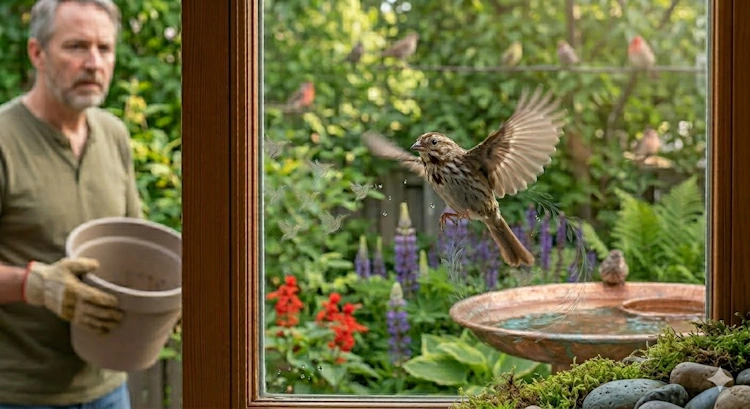
If you love watching backyard birds, few things are more heartbreaking than finding a stunned or injured bird under your window. Learning how to prevent birds from hitting windows is one of the most impactful things you can do to protect local wildlife, as up to 1 billion birds die from window collisions in the U.S. alone each year, per The Guardian. The good news? Most strikes are entirely preventable with simple, affordable adjustments to your home.
Why Do Birds Hit Windows?
Birds do not perceive glass the same way humans do. Their visual systems are evolved to detect motion, track prey, and navigate through foliage, not distinguish transparent or reflective panes from open sky or greenery. Understanding why strikes happen is the first step to stopping them.
The Reflection Problem
On bright, sunny days, windows act as mirrors, reflecting surrounding trees, clouds, and open sky. To a bird, this reflection looks like a clear, unobstructed flight path. This issue is most common with large picture windows or glass that faces gardens, wooded areas, or open yards where birds spend time feeding and nesting.
The Transparency Trap
Even non-reflective windows can trick birds. If a window looks out onto a tree, or if there is a second window on the opposite side of the room, birds may see greenery or light through the glass and attempt to fly straight through. Strikes often happen in pairs: one bird hits the glass, and a second bird following it makes the same mistake moments later.
Artificial Light at Night
Nocturnal migratory birds are especially vulnerable to window collisions. They navigate using natural light from the moon and stars, but artificial lights from homes, offices, and streetlights disorient them. These birds may circle lit buildings until they collide with windows, or become exhausted and crash into glass while trying to reach what they think is open sky.
7 Proven Ways to Prevent Bird Window Strikes
You do not need to replace your windows or spend hundreds of dollars to keep birds safe. These seven methods are tested by wildlife experts and work for homes of all sizes, from small apartments to large rural properties.
Apply High-Contrast Window Decals
Decals are the most popular solution for window strikes, but not all options are effective. For a decal to work, it must break up the reflection or transparency of the glass so birds recognize the window as a solid barrier. The American Bird Conservancy recommends the “2×4 rule”: decals should be spaced no more than 2 inches apart horizontally and 4 inches apart vertically to block even small birds from flying through gaps.
We’ve tested dozens of options in our guide to the best window decals for birds, which includes picks that meet the 2×4 rule and hold up to rain, snow, and direct sunlight. If you’re skeptical about whether these small stickers make a difference, our breakdown of whether window decals work for birds shares real-world test results from backyard birders and wildlife researchers.
- Choose decals with high contrast (black, white, or bright orange work best) rather than clear or pastel options.
- Cover the entire window surface, not just the center, as birds often fly near the edges of glass.
- Avoid decorative decals shaped like single birds or flowers, as these can actually attract birds instead of deterring them.
Install Exterior Screens or Netting
Screens that sit 2-3 inches away from the exterior of your window are one of the most effective long-term solutions. They break up reflections, and if a bird does hit the screen, it bounces off softly instead of colliding with hard glass. You can use permanent insect screens, or temporary netting for windows that only have strike problems during migration seasons.
- Choose netting with a mesh size no larger than 0.5 inches to prevent birds from getting tangled.
- Secure netting tightly so it does not sag, which can create gaps that birds fly into.
- Remove netting during severe weather to prevent damage, unless it is rated for year-round use.
Move Indoor Plants Away from Windows
Indoor plants placed directly in front of windows are a major attractant for birds. They see the greenery through the glass and try to fly to it, not realizing there is a barrier in the way. Moving plants at least 3 feet away from windows, or placing them in rooms that do not have frequent strike problems, eliminates this temptation.
If you love having plants near your windows, swap live greenery for artificial plants that do not attract insects, which are another draw for insect-eating birds.
Use Exterior Shutters or Blinds
Exterior shutters or blinds that are closed partway break up the reflection of the glass. Interior blinds are less effective, as birds can still see through the slats, but exterior options block the reflection entirely when closed. For maximum effectiveness, keep shutters or blinds closed during peak bird activity times: dawn and dusk, when most strikes occur.
Reduce Nighttime Artificial Light
Turning off unnecessary lights at night is one of the easiest ways to protect migratory birds. If you need to keep lights on for security, use motion-sensor lights instead of constant illumination, and choose warm-colored LED bulbs (2700K or lower) which are less disorienting to birds than cool blue-toned lights.
Closing curtains or blinds at night also helps, as it blocks interior light from shining through the glass and attracting nocturnal birds.
Place Bird Feeders Strategically
Bird feeders placed too close to windows can actually increase strike risks, as birds fly quickly from the feeder to the window. Feeders placed more than 30 feet away from windows give birds enough space to slow down if they fly toward the glass. Alternatively, place feeders less than 3 feet from windows: birds cannot build up enough speed to hurt themselves if they hit the glass at that close range.
Add Window Film or Tape
If decals are not your style, apply non-reflective window film or patterned tape to the exterior of your glass. UV-reflective film is invisible to humans but glows brightly to birds, which can see UV light that humans cannot. Patterned tape (like stripes or dots) works similarly to decals, following the same 2×4 spacing rule for maximum effectiveness.
- Apply film or tape to the exterior of the window, not the interior, as interior applications do not break up reflections.
- Choose removable film if you rent your home, so you can take it down when you move out.
Common Mistakes to Avoid
Even well-meaning bird lovers make mistakes that reduce the effectiveness of their prevention efforts. Here are the most common errors to skip:
Relying on Single or Sparse Decals
A single decal in the center of a large window does almost nothing to prevent strikes. Birds will simply fly around the decal and hit the glass. Remember the 2×4 rule: decals must be spaced no more than 2 inches apart horizontally and 4 inches apart vertically to be effective.
Using Only Interior Curtains
Thin interior curtains or sheers do not block reflections enough to deter birds. If you use curtains, choose thick, blackout options that block all light from passing through the glass, and keep them closed during peak bird activity times.
Buying Ultrasonic Deterrents
Many companies sell ultrasonic devices that claim to deter birds from windows, but there is no scientific evidence that these work. Birds cannot hear most ultrasonic frequencies, and even if they could, these devices do not address the root cause of strikes: reflective or transparent glass. Save your money for proven solutions like decals or screens.
Frequently Asked Questions
How many birds die from window strikes each year?
Estimates from the Cornell Lab of Ornithology put the number at up to 1 billion birds in the U.S. alone each year, with 44% of those strikes happening at residential homes. That makes residential window strikes one of the top human-caused threats to bird populations, alongside habitat loss and outdoor cats.
Do window decals work for all bird species?
Yes, when applied correctly. The 2×4 spacing rule works for all bird sizes, from tiny hummingbirds to large hawks. However, some species (like woodpeckers) may be more persistent, so you may need to combine decals with other methods like screens if you have frequent woodpecker strikes.
Can I use hawk decals to scare birds away?
No, hawk decals are not effective for preventing window strikes. Birds quickly realize the decal is not a real predator, and the single decal does not break up the reflection of the glass. Stick to high-contrast patterns that cover the entire window instead.
Are there window treatments that are safe for birds and let in light?
Yes, UV-reflective window film is a great option. It is nearly invisible to humans, so it lets in plenty of natural light, but glows bright white or purple to birds, which can see UV light. This alerts them to the glass without blocking your view.
Conclusion
Preventing bird window strikes does not require a complete home renovation. Start with the easiest, most affordable method: applying high-contrast decals that follow the 2×4 spacing rule. If you have frequent strikes, add exterior screens or move indoor plants away from windows. Every small change you make adds up to save hundreds of bird lives over time.
Remember, birds do not hit windows on purpose—they are just trying to navigate a world that is full of unexpected barriers. By taking a few simple steps to make your windows visible to birds, you can enjoy watching your backyard visitors without the heartbreak of finding injured birds under your glass.
Hassan is a lifelong backyard birding enthusiast and the creator of Birdhouse Tales. Turning a passion for nature into a mission, they spend their days designing bird-approved DIY nesting boxes, testing squirrel-proof gear, and curating the best advice to help homeowners build safe wildlife sanctuaries. Whether you are trying to attract your first pair of bluebirds or looking for the perfect copper birdbath, Hassan provides practical, real-world guides to bring the joy of birdwatching right to your window.