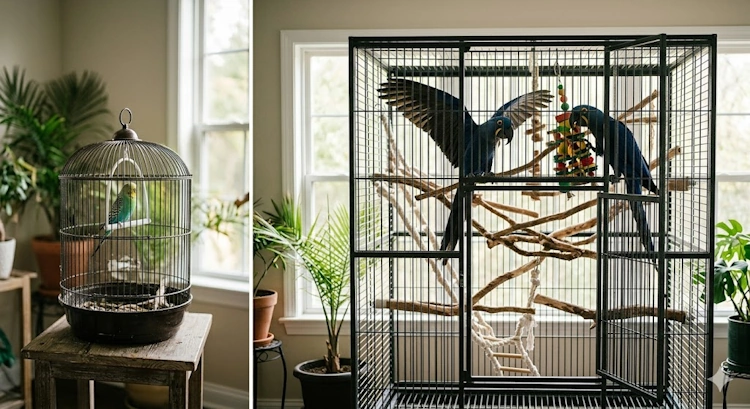
If you’re a new or prospective parrot owner, the first question you’ll probably ask is how big should a parrot cage be for your specific bird. It’s a far more important decision than most people realize: a cage that’s too small doesn’t just feel cramped, it can cause irreversible physical harm and severe behavioral issues for your feathered companion.
Unlike cats or dogs, parrots are built for near-constant movement. Even small budgies fly miles daily in the wild, while large macaws cover vast distances to forage. A captive parrot’s cage is its primary habitat, so getting the size right is the foundation of its lifelong health. This guide breaks down exact size requirements by species, explains the golden rules of cage sizing, and helps you avoid common mistakes that many new owners make.

68” Large Parrot Cage, Large Bird Cages for Parrots,Conure Cage for Birds, Cockatiel Cage with Play Top,Feeders,Slide-Out Tray,Seed Catcher,Birdcage Toys for Cockatoo,African Grey,Lovebird
Check PriceWhy Cage Size Matters More Than You Think
Parrots have unique anatomical needs that most small pet owners don’t consider. Their wings are designed for sustained flight, and their feet are adapted for climbing, grasping, and manipulating objects. When a cage is too small to let them fully extend their wings, climb freely, or move between perches without brushing the bars, their muscles weaken over time. This leads to muscle atrophy, obesity, and joint pain, especially in large, heavy species like cockatoos.
Behavioral issues are even more common. Bored, cramped parrots often develop destructive habits like feather plucking, excessive screaming, and chewing on cage bars. They may become aggressive toward owners or other birds, simply out of frustration. As outlined in expert guidelines from The Humane Society, properly sized cages are one of the top factors in reducing stress and extending a parrot’s lifespan, which can reach 50+ years for large species.
It’s also worth noting that height is less important than width. Parrots move horizontally far more than they move vertically: they climb side to side, hop between perches at the same height, and flap their wings side to side. Tall, narrow “skyscraper” cages are a common mistake, as they provide very little usable floor or perch space relative to their total size.

Yaheetech 61-inch Playtop Wrought Iron Large Parrot Bird Cages with Rolling Stand for Cockatiels Amazon Parrot Quaker Conure Parakeet Lovebird Finch Canary Small Medium Parrot Cage Birdcage, Black
Check PriceThe Golden Rule of Parrot Cage Sizing
Instead of guessing based on cage labels, always size your parrot’s cage based on its wingspan. To measure this, gently extend one wing fully, then the other, and measure from the tip of one primary feather to the tip of the other. This is your bird’s full wingspan, and it’s the only reliable metric for sizing.
Follow these three non-negotiable minimums:
- Width: At least 1.5x your parrot’s wingspan. This lets them fully extend their wings and flap without hitting the side bars.
- Depth: At least 2/3 of your parrot’s wingspan. This gives them enough room to move front to back between perches and food bowls.
- Height: At least 1x your parrot’s wingspan, though taller is better as long as width minimums are met first.
Bar spacing is just as critical as total dimensions. If bars are too far apart, your parrot can get its head stuck, escape, or get a limb caught. If bars are too close together, the cage feels dark and cramped, and small parrots may struggle to climb. Use these bar spacing guidelines:
- Small parrots (budgies, lovebirds): 0.5–0.6 inches
- Medium parrots (conures, Quakers): 0.75–1 inch
- Large parrots (African Greys, Amazons): 1–1.5 inches
- Extra large parrots (macaws, cockatoos): 1.5–2 inches
Opt for cages with horizontal bars rather than vertical ones. Parrots climb like ladders, gripping bars with their feet, and horizontal bars make this much easier. Avoid cages with decorative scrollwork, built-in nests, or other features that reduce usable interior space.

Yaheetech 69-Inch Extra Large Bird Cage Metal Parrot Cage for Mid-Sized Parrots Cockatiels Conures Parakeets Lovebirds Budgie Finch, Black
Check PriceSpecies-Specific Parrot Cage Size Chart
Every parrot species has different size and activity needs. Below are minimum cage dimensions for a single adult bird of each size category. Add 50% to the width for each additional bird sharing the cage.
Small Parrots (Budgies, Parakeets, Lovebirds, Cockatiels)
Small parrots have wingspans ranging from 10 to 20 inches. Budgerigars (common parakeets) have a 10–12 inch wingspan, lovebirds 10–11 inches, and cockatiels 18–20 inches. Minimum dimensions for one bird:
- Budgie/parakeet: 18″ W x 18″ D x 24″ H
- Lovebird: 20″ W x 18″ D x 24″ H
- Cockatiel: 24″ W x 20″ D x 30″ H
These active little birds need space for multiple perches, toys, and food bowls without crowding. For pre-vetted options that meet these standards, check our guide to the best cages for budgies and small parrots.
Medium Parrots (Conures, Quaker Parrots, Pionus, Senegal Parrots)
Medium parrots have wingspans between 20 and 30 inches. Green-cheeked conures have an 18–22 inch wingspan, Quaker parrots 18–20 inches, and Pionus parrots 24–28 inches. Minimum dimensions for one bird:
- Conure/Quaker: 24″ W x 24″ D x 36″ H
- Pionus/Senegal: 30″ W x 24″ D x 40″ H
These parrots are heavy chewers, so you’ll need space for multiple destructible toys to keep them entertained. Bar spacing should be 0.75–1 inch to prevent escapes.
Large Parrots (African Greys, Amazons, Eclectus)
Large parrots have wingspans of 28 to 40 inches. African Greys have a 28–32 inch wingspan, Amazons 30–38 inches, and Eclectus parrots 30–36 inches. Minimum dimensions for one bird:
- African Grey/Amazon: 36″ W x 30″ D x 48″ H
- Eclectus: 40″ W x 30″ D x 60″ H
These highly intelligent species need multiple perches at different heights, plus space for puzzle toys and foraging opportunities. Bar spacing should be 1–1.5 inches, and cages should have sturdy locks, as these parrots are smart enough to open simple latches.
Extra Large Parrots (Macaws, Cockatoos)
Extra large parrots have wingspans of 36 to 60 inches. Blue-and-gold macaws have a 40–48 inch wingspan, and Moluccan cockatoos have a 48–60 inch wingspan. Minimum dimensions for one bird:
- Medium macaw (blue-and-gold): 48″ W x 36″ D x 60″ H
- Large cockatoo (Moluccan): 60″ W x 48″ D x 72″ H
These powerful birds are extremely destructive, so cages must have heavy-duty steel bars with 1.5–2 inch spacing. They need ample space to move, as they are prone to obesity if confined to small cages.
Common Cage Sizing Mistakes to Avoid
- Prioritizing height over width: As mentioned earlier, width is far more important for parrot movement than height. A short, wide cage is always better than a tall, narrow one.
- Forgetting about usable space: Toys, perches, food bowls, and water dishes take up interior space. Always size up to account for these essentials, don’t just measure the empty cage.
- Buying a “starter” cage for growing birds: If you’re getting a baby parrot, buy the adult-size cage from the start. Moving cages later is stressful for birds, and you’ll save money in the long run.
- Ignoring bar spacing: A cage that’s the right size but has bars spaced too far apart is dangerous. Always check bar spacing before purchasing.
Tips for Picking the Right Parrot Cage
Once you’ve determined the right size for your bird, look for these additional features:
- Removable bottom tray for easy cleaning
- Secure door locks that your parrot can’t open
- Non-toxic powder coating (avoid galvanized steel, which can release toxic zinc fumes)
- Rolling casters so you can move the cage for cleaning or to follow sunlight
For a curated list of options that meet all avian vet recommendations, visit our guide to the best parrot cages for all species.
Frequently Asked Questions
FAQ
- Can a parrot cage be too big? No, as long as bar spacing is appropriate for your bird’s size. Bigger cages provide more opportunities for enrichment and exercise.
- Do I need a bigger cage for multiple parrots? Yes, add 50% to the cage width for each additional bird. Each bird should have its own perch, food bowl, and water dish.
- What if my parrot’s wingspan is between sizes? Always size up. It’s far better to have extra space than to risk a cage that’s too small.
- Are flight cages better than standard parrot cages? Flight cages are wider and shallower than standard cages, which aligns perfectly with parrot movement needs. They are an excellent choice for most species.
- How often should I clean my parrot’s cage? Spot clean daily, and do a full deep clean with bird-safe disinfectant once a week.
Conclusion
Answering how big should a parrot cage be comes down to one simple metric: your bird’s wingspan. Prioritize width over height, follow the 1.5x wingspan rule for width, and always check bar spacing before purchasing. A properly sized cage will keep your parrot healthy, happy, and entertained for decades to come.
If you’re unsure about your current cage, measure your parrot’s wingspan today and compare it to the guidelines above. Upgrading to a larger cage is one of the best investments you can make in your bird’s quality of life.

Hassan is a lifelong backyard birding enthusiast and the creator of Birdhouse Tales. Turning a passion for nature into a mission, they spend their days designing bird-approved DIY nesting boxes, testing squirrel-proof gear, and curating the best advice to help homeowners build safe wildlife sanctuaries. Whether you are trying to attract your first pair of bluebirds or looking for the perfect copper birdbath, Hassan provides practical, real-world guides to bring the joy of birdwatching right to your window.