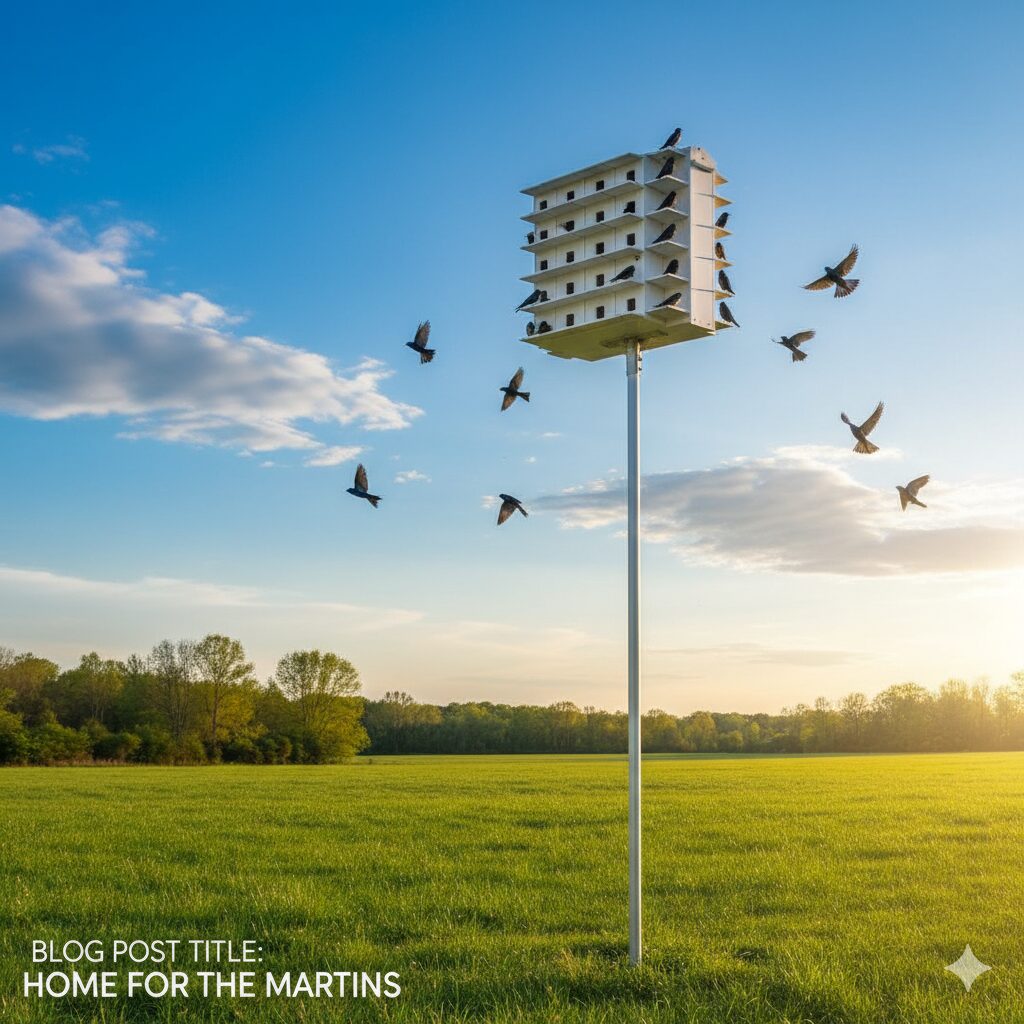
Welcome to the most rewarding challenge in all of backyard birding. Attracting and hosting a colony of Purple Martins is unlike any other birding experience. You’re not just a birdwatcher; you become a landlord to a vibrant, chattering community of aerial acrobats. These magnificent swallows are famous for their iridescent purple-black feathers, their graceful flight, and their complete reliance on humans in the Eastern U.S. for nesting.
For millennia, Native Americans hung up hollowed-out gourds to attract them. Today, that tradition continues, but with a critical twist: Purple Martins are exceptionally picky about their neighborhood.
You can buy the most expensive, beautiful martin house on the market, but if you place it 20 feet in the wrong direction, it will sit empty. Forever. Unlike a chickadee or a wren, which might eventually settle for a less than perfect spot, Purple Martins will simply not compromise. Their survival depends on it.
This is the definitive guide to Purple Martin house placement. We will cover every non-negotiable rule, every common mistake, and every expert tip to transform your yard into the most desirable Purple Martin real estate on the block. Get this right, and you’ll be rewarded with a spectacular show all summer long.
The 5 Non-Negotiable Rules of Purple Martin Placement
Let’s be clear: these are not guidelines or suggestions. These are the laws of Purple Martin real estate. If you cannot meet these requirements, especially Rule 1, you will unfortunately not be able to host a colony. But if you can, your chances of success skyrocket.
1: The Open Space Rule (The 60-Foot+ Radius)
This is the single most important rule. If you remember nothing else, remember this: Purple Martins need wide-open space.
Your Purple Martin house must be placed in the center of the largest, most open space available on your property. The traditional rule is a 40-foot radius, but in our experience, a 60-foot (or more) radius in every direction, free of trees and buildings, is far more successful.
- Why? Purple Martins are aerial insectivores. They hunt (and even drink) on the wing, catching insects in mid-air. They need a long, clear swoop space or glideslope to approach and leave their house at high speed, just like an airplane runway.
- What is an Obstruction? Any tree, building, or tall, dense shrubbery. A small, decorative bush is fine, but a 30-foot-tall oak tree is a major problem.
- The Predator Factor: This open space is their primary defense against their most feared predators: hawks and owls. A hawk cannot launch a surprise attack from a nearby tree if there are no nearby trees. The martins can see them coming from hundreds of yards away and mob them as a group. A house placed too close to a tree is a death trap, and they know it.
How to Test Your Spot: Stand where you want to put your pole. Look 360 degrees. Are there any tall trees or buildings within 60 feet? If the answer is no, you have a prime location. If the answer is yes, you need to find a more open spot.
2: The Human Shield Rule (The 30-120 Foot Zone)
This is what makes martins so unique. While most birds like a quiet, secluded spot away from people, Purple Martins prefer to be near human activity.
The ideal placement is between 30 and 120 feet from your house or deck.
- Why? They have learned over centuries that where there are humans, there are fewer hawks and owls. Our presence acts as a human shield, deterring these top predators. They want to see you mowing the lawn, grilling on the patio, or playing in the yard.
- What’s Too Close? Under 30 feet can be too much activity, with doors slamming and constant foot traffic directly under the house.
- What’s Too Far? Over 120-150 feet, and they’ll start to feel isolated and vulnerable to predators. That wide-open field 300 yards away from your house is not as good as the open part of your backyard.
This rule often works in harmony with Rule 1. The perfect spot is typically in the middle of a large, open backyard, within clear view of the human-dwelling.
3: The Height Rule (The 12-20 Foot Zone)
Your Purple Martin house needs to be high, but not too high. The ideal height for the bottom of the house is 12 to 20 feet off the ground.
- Why 12 Feet (Minimum)? This height protects the colony from ground predators like raccoons, cats, and snakes (though a pole guard is still 100% necessary). It also gives them a better vantage point.
- Why 20 Feet (Maximum)? Anything higher becomes a wind-tunnel that is less desirable. More importantly, it becomes extremely difficult for you to manage. You cannot simply hang a martin house and forget it. You must be able to lower it for nest checks and cleaning. A 30-foot-tall house is an unmanageable, and therefore, an unsafe house.
This rule leads directly to the most important piece of hardware you’ll buy…
4: The Manageable Pole Rule (No Exceptions)
This is a rule about your equipment, and it’s non-negotiable. Your Purple Martin house MUST be on a pole that allows you to easily lower and raise the house vertically.
You cannot be a successful Purple Martin landlord without this. You will need to lower the house, often once a week, to conduct nest checks a process of counting eggs, removing any pest nests (like House Sparrows), and checking for parasites. You’ll also need to lower it to clean it at the end of the season. Learn more about the general process in our guide to cleaning a birdhouse.
Your options for a manageable pole are:
- Telescoping Pole: These poles have sections that slide down. They are easy to use and very popular.
- Winch or Pulley System: For heavier houses or gourd racks, a winch is the gold standard. You simply crank the house up and down.
NEVER use a fixed wooden post or a pole that requires a ladder. Tipping a house on a hinge is also disastrous, as it will dump out all the eggs and nestlings. The system must move straight up and down. This is why the best birdhouse poles for martins are these specific, manageable systems.
5: The Water Nearby Rule (A Bonus, Not a Must)
You will often hear that you must have a pond, lake, or river nearby. This is a soft rule. It is a huge bonus, but no longer a requirement.
- Why it Helps: Martins drink on the wing by skimming the surface of the water. A nearby water source is a huge convenience for them and a major source of their favorite food: flying insects like dragonflies.
- What if I Don’t Have Water? Don’t worry! In the last few decades, Purple Martins have been successfully colonizing upland sites far from water. They can get the moisture they need from insects and will fly to find water when they need it.
The Verdict: If you have two potential spots, one open and one equally open but next to a pond, choose the one by the pond. But do not let a lack of water stop you if you can meet Rules 1-4. A perfect upland site is better than a water site that’s full of trees.
Placement Rules: At a Glance
- Space: 60-foot (or more) radius free of tall trees or buildings.
- Human Proximity: 30 to 120 feet from your home.
- Height: 12 to 20 feet high (bottom of house).
- Pole: MUST be a telescoping or winch-operated pole for nest checks.
- Water: A bonus, but not a requirement.
Essential Gear for a Successful Colony
Your placement can be perfect, but you’ll fail if your equipment isn’t up to the task. Here are the non-negotiable items you’ll need, all of which are designed to work together.
Heath Manufacturing 24-Room Deluxe Purple Martin House

This is the pole you need for a house like the Heath. It’s a 16-foot, 3-section telescoping pole that is specifically designed for martin houses. It allows you to set the 16-foot height and, more importantly, easily lower the house down for your essential nest checks. It’s made of heavy-duty galvanized steel and comes with a ground socket for stability. Do not try to mount your house on anything else. This is one of the best birdhouse poles for this exact purpose.
Pros:
- Allows for essential nest checks
- 16-foot height is in the sweet spot
- Easy key-lock system for raising/lowering
- Durable galvanized steel
Cons:
- Can be difficult to lower when new (requires strength)
- Not ideal for very heavy/large houses
S&K Manufacturing 12-Family Gourd Rack System with Winch
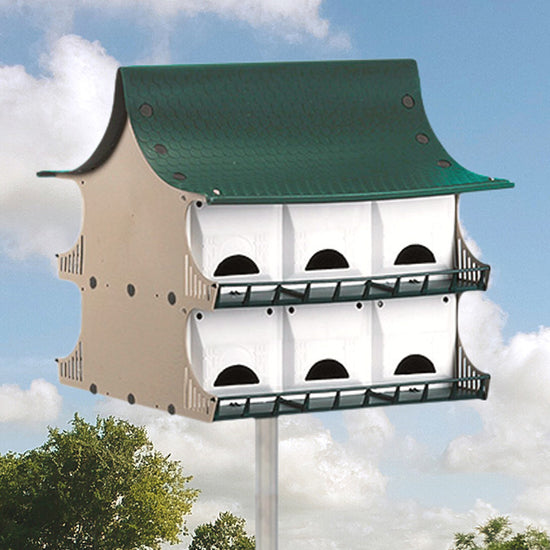
This is what many professional landlords graduate to. This system includes a 16-foot pole, a 12-gourd hanging rack, AND a pulley-winch system. Birdhouse gourds are highly attractive to martins, mimicking their original natural nesting sites. This all-in-one kit makes management a breeze. A simple crank of the winch raises and lowers the entire rack for nest checks.
Gourds also have excellent drainage and reduce parasite issues. If you’re serious about starting a colony, this is a top-tier investment. (Gourds sold separately).
Pros:
- Winch system is extremely easy to use
- Gourd setup is highly desirable for martins
- Sturdy, all-in-one system
- Expandable (can add more gourds)
Cons:
- Higher initial investment
- Gourds must be purchased separately
Stokes Select 8-Inch Raccoon and Squirrel Baffle

Your colony will be found by a raccoon or a snake. Not if, but when. If you do not have a baffle, you will lose every single egg and nestling. A predator will climb the pole and destroy your entire colony in one night. This baffle is the only thing that stops them. It must be at least 4-5 feet off the ground (to prevent raccoons from jumping over it) and must be wide enough (like this 8-inch model) to stop them. Do not, under any circumstances, skip this item.
Pros:
- 100% essential for protecting your colony
- Stops raccoons, snakes, squirrels, and cats
- Durable steel construction
- Mounts easily to any pole
Cons:
- None. This is not optional.
Heath Manufacturing Purple Martin Decoy

Purple Martins are social. Colony is the keyword. They are attracted to sites that already have other martins. When you’re starting a new site, you have no martins. How do you fix this? You fake it. A decoy perched on the house or a nearby perch signals to passing scouts that this site is active and safe. It’s a cheap, low-tech trick that dramatically increases your odds of being noticed. Many landlords swear by them. For a few bucks, it’s a no-brainer to add one or two to your setup.
Pros:
- Provides social proof to passing martins
- Lifelike and durable
- nexpensive and easy to install
- Greatly improves new site attraction
Cons:
- Must be mounted securely to withstand wind
The Silent Killer of Placement: Managing Competitors
You can have a $1,000 setup in a perfect, wide-open field, and it will fail 100% of the time if you let invasive species take over. Your two greatest enemies are the House Sparrow and the European Starling.
These aggressive birds, which are not native to the U.S. and are not protected by law, will kill adult martins, destroy their eggs, and kill their nestlings to steal the nesting cavity. Managing them is part of your placement strategy. A site that is safe from these pests is a prime location.
1. The Starling Solution: SREH
European Starlings are larger than martins. We can defeat them with simple geometry. Starling-Resistant Entrance Holes (SREH) are specially-shaped entrances (often crescent, Excluder, or Conley 2″ shaped) that a Purple Martin can wiggle through, but a starling cannot. If your house has standard 2 round holes, you must block them or add SREH plates. Many modern birdhouse gourds come with SREH entrances pre-molded.
2. The House Sparrow Solution: Constant Vigilance
House Sparrows are smaller than martins, so they can fit into any hole a martin can. SREH will not stop them. The only solution is active management.
- Nest Removal: This is why your pole must be manageable. You must lower the house every 4-7 days and pull out any trashy nest of grass and garbage that a House Sparrow is building.
- Traps: Many landlords use in-house traps that safely capture the sparrow inside the compartment, allowing you to remove it.
- Don’t Encourage Them: Do not offer cheap mixed bird seed or millet near your martin colony, as this is a primary food source for sparrows.
This is a hard truth of the hobby: you cannot be a passive martin landlord. You must be an active protector. This is also why we have a full guide on how to get birds to nest in your birdhouse, and for martins, it involves active defense.
Warning: Other Pests
Besides competitors, you need to watch for wasps and ants. Keeping wasps out of birdhouses can be done by rubbing the inside roof of the compartments with a bar of soap (they can’t make their nests stick). A ring of grease on the pole (below the baffle) can deter ants.
When to Place Your House: The Grand Opening Strategy
Placement isn’t just about where, it’s also about when. You cannot just leave your house open all year. House Sparrows will take it over in the winter and you will never get them out. Your placement strategy must include a timeline.
Purple Martins migrate from Brazil. The first to arrive are the scouts, which are older adult males. They are followed 3-4 weeks later by the sub-adults (SY, or second-year birds), which are the ones most likely to colonize a new site.
- Step 1: Find Your Scout Arrival Date. This is different for Texas (late Jan) vs. Pennsylvania (mid-April). You can find maps online from the Purple Martin Conservation Association.
- Step 2: Keep Your House CLOSED. All winter, your house should be closed. Block the entrance holes with tape, foam plugs, or plates. This prevents sparrows from claiming it.
- Step 3: The scout Opening. Open your house (or just a few compartments) about 1-2 weeks before the first scouts are due in your area. This makes it available for the experienced birds.
- Step 4: The SY Opening. If no scouts claim your site, don’t give up! The real opportunity is when the sub-adults arrive, about 3-4 weeks later. These teenager birds were shut out of established colonies and are desperately seeking a new, safe site. This is your primary audience!
Your first year is all about attracting these SY birds. This is where your decoy and dawn song (a recording of martin calls played at dawn) can be most effective.
Your First-Year Placement Checklist: Common Mistakes to Avoid
Let’s summarize everything into an actionable checklist. A yes to all these questions means you’re in a great position.
- The 60-Foot Test: Is my pole location at least 60 feet from the drip line of the nearest tall tree?
- Human Test: Is the pole 30-120 feet from my house, patio, or area of regular human activity?
- The Height Test: Is the pole system 12-20 feet tall?
- Management Test: Is the pole a telescoping or winch-operated pole? (If no, STOP and buy one.)
- Predator Test: Do I have an 8-inch+ raccoon/squirrel baffle ready to install on the pole? (If no, STOP and buy one.)
- Competitor Test: Are my house’s entrance holes SREH? Or, if round, do I have a plan for active sparrow management?
- Timing Test: Do I know my local scout arrival date and have a plan to keep the house closed until then?
Common Placement Mistakes We See:
- Tucked In House: The landlord thinks a spot tucked in by a few trees is cozy. It is not. It is a death trap. Needs to be in the middle of the yard.
- Fire & Forget: The landlord uses a 4×4 wooden post and a ladder. They cannot perform nest checks, and House Sparrows take over. The colony fails.
- The No Baffle House: The landlord has a thriving colony for 2 months, then a raccoon finds it. The entire colony is destroyed in one night and will not return.
Pro Tip: Setting up a major pole system often requires concrete mix, wrenches, and a level. While you’re organizing your shed for this big project, make sure you don’t get locked out! One of the best key hiders, disguised as a rock in your garden bed, is a lifesaver.
Final Thoughts: You Are a Conservationist
Becoming a Purple Martin landlord is a serious, long-term commitment. It can take longer than you think to attract your first pair—sometimes 2-3 years. But the process is a critical act of conservation. Eastern Purple Martins are one of the few birds that use birdhouses almost exclusively, and their populations depend entirely on dedicated people like you.By following these placement rules, you are creating a safe, sustainable, and defensible habitat. You are giving this incredible species a fighting chance. The reward—that first chattering call as a scout investigates your house, the first sight of a fledgling taking its first flight—is an experience that will have you hooked for life.
Frequently Asked Questions (FAQ)
What direction should a Purple Martin house face?
Honestly, it doesn’t matter much. Unlike smaller houses, the martins can enter from any direction. If you have SREH (crescent) holes, some landlords orient them North/South. But it’s not a critical factor. Open space is 100x more important. This is different from single-family houses, where our guide on what direction a birdhouse should face recommends East.
What do I put inside a Purple Martin house?
Just like with most birds, the answer to what to put inside a birdhouse is almost nothing. However, martins are an exception. They build a very simple nest, often just a mud dam. To encourage them, you can add a 1-inch-thick layer of pre-nesting material like dry, unfertilized pine straw or cedar shavings. This makes the compartment more attractive.
Do Purple Martins use birdhouses in winter?
No. They are long-distance migrants and spend their winter in South America. This is unlike many of our resident birds. You might wonder, do birds use birdhouses in winter? Yes, birds like chickadees and bluebirds do, for roosting. But your martin house will be empty, which is why you must clean it and close it for the season.
What other birds can I attract?
Your open-space martin setup is very specific. You likely won’t attract wrens or chickadees, who prefer houses closer to cover. To attract them, you’d need a separate setup. See our guides on how to attract wrens and the best birdhouse for chickadees. And remember, cardinals will not use a birdhouse at all, nor will hummingbirds.
Can I build my own martin house?
You can! But it’s an advanced project. The compartments must be the right size (6″x6″ at a minimum 6″x12″ is better). You can find simple DIY birdhouse plans for smaller birds, but a martin house is a big step up. You can also grow gourds for birdhouses and dry them yourself, which is a very traditional method.
What about paint and wood?
Martin houses should always be painted white. The best paint for a birdhouse, in this case, is a high-quality, white exterior latex paint. This reflects the sun and prevents the compartments from overheating, which can kill nestlings. This is a must. Dark colors or natural colors that birds like on other houses (like tan or green) are wrong for martins. For wood, the best birdhouse wood is fine, but aluminum is often preferred for its low weight and heat reflection.
Do birds sleep in birdhouses? And when do they wake up?
Yes, many birds sleep in birdhouses, especially for roosting in winter. During nesting season, the female martin will sleep in the house every night. As for if they sleep in the same place, the nesting female does, but other birds may vary. Martins are early risers. A bird’s 24-hour clock is tied to the sun, and martins are famous for their dawn song, which starts well before sunrise.
How can I watch them up close?
A window bird feeder won’t work for martins, as they don’t eat seed. But, a birdhouse with a camera is a fantastic idea! Many landlords install a wireless birdhouse camera inside one of the compartments to get an incredible view of the nesting process. Check our birdhouse reviews for more ideas. And once you’re hooked, you can even take your hobby on the road with our birdwatching road trip guide!
What are the ideal dimensions for a martin house?
Older houses used 6″x6″ compartments. This is now considered the bare minimum and can lead to lower fledgling success. Modern, high-quality houses and gourds use larger 6″x12″ compartments. This gives the nestlings more room and protects them from predators reaching in. For hole sizes and more, check our birdhouse dimensions chart.
Where to hang birdhouse hooks?
This is a common question, but birdhouse hooks are not for Purple Martin houses. They are for smaller, hanging houses for wrens or chickadees. A martin house must be on a dedicated pole. Our guide on where to hang a birdhouse covers these other types in more detail.
Sanom is a lifelong nature enthusiast and passionate backyard birder who has spent years observing bird behavior and building DIY birdhouses. With a deep curiosity for species like chickadees, wrens, and woodpeckers, he shares practical tips and heartfelt stories to help others attract, shelter, and appreciate the wild birds around them. Whether you’re crafting your first birdhouse or simply enjoying morning songbirds, Iftekhar’s guides on BirdHouseTales.com are designed to bring you closer to the magic of birdwatching.